
Share This Story!
By Tom Jenz, Shepherd Express
Long before Black history was written into textbooks or debated in classrooms, it was sung, painted, danced, woven, spoken and shouted. Art has never been a side note in the Black experience, but rather a survival tool, a form of resistance. For Black people, art provided a way of remembering when Black culture was under threat.
Through the strength of spirituals sung in fields and church houses, enslaved people carried coded messages of grief and hope from one generation to the next. In America, during Reconstruction and Jim Crow, blues musicians turned everyday suffering into testimony, shaping a shared language of endurance. Music continued that lineage. Nina Simone and James Brown fused art with defiance, while later artists like Public Enemy and Kendrick Lamar transformed hip-hop into a living historical record of life on the streets.
On canvas and in galleries, artists such as Faith Ringgold and Kehinde Wiley reimagined who belongs in the frame of American art. In the Harlem Renaissance, writers and painters like Langston Hughes, Zora Neale Hurston and Jacob Lawrence insisted through words and art that Black life was intellectual and worthy of permanence. In literature and the spoken word from James Baldwin to Amanda Gorman, language itself became a connecting bridge across generations.
On stage and screen, actors from Paul Robeson to Sidney Poitier to Denzel Washington challenged narrow roles and expanded the emotional vocabulary of Black life. Then, there were film directors, Gordon Parks and Spike Lee.
In this Black History Month of 2026, Milwaukee’s Bronzeville Center for the Arts (BCA) is carrying on this long tradition. Still in the development process, the BCA is bringing to inception an African American art museum in Milwaukee’s Bronzeville community on the corner of North Avenue and Martin Luther King Drive.
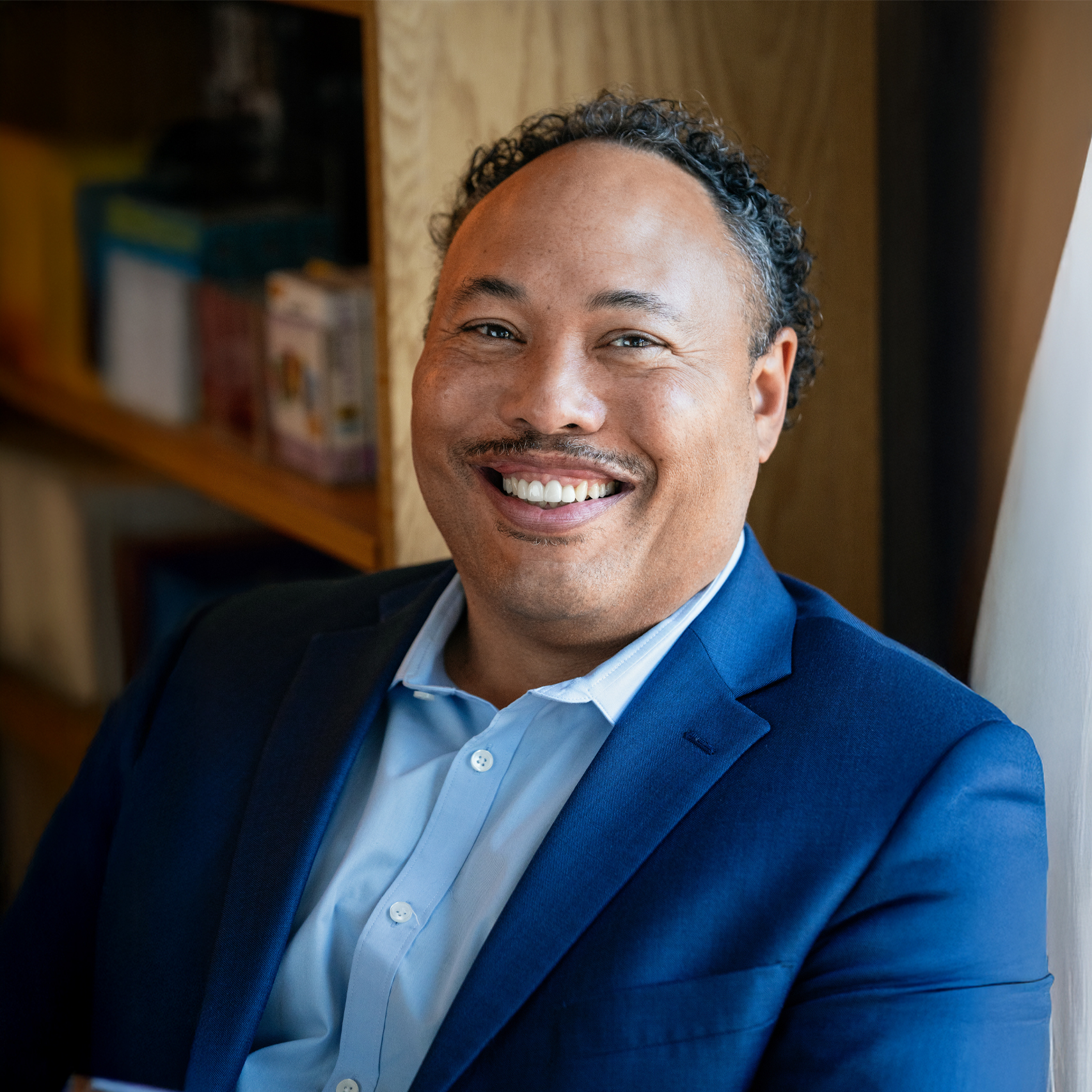
I wanted the details, and met with the new executive director, Ra Joy, and the BCA board vice chair, Della Wells, at Gallery 507, the BCA headquarters, (507 W. North Ave.) near the future site of the BCA museum. Joy recently served at the National Endowment for the Arts in the Biden-Harris Administration. Wells, a long time Milwaukee resident, is a nationally known folk artist.
Ra, you are known nationally in the arts field. The BCA recently hired you as executive director. Tell me about where you grew up, your parents, neighborhoods, schools and advanced education.
R.J.: I was born and raised in Evanston, Illinois. My father was a graphic artist, and he created wonderful works of art with his bare hands. He inspired me to get more involved in the arts. I attended Evanston Township High School and was captain of the football team. I went to Southern Illinois University, played football and participated in AmeriCorps, kind of a domestic peace corps. This motivated me to come back home to Illinois and get involved in community work.
I understand you later got involved working for an Illinois congressman.
R.J.: Yes, I was a staffer for a congressman from the Illinois 9th congressional district. The 9th district has always been a big supporter of the arts and the National Endowment for the Arts. I focused on arts policy. Working in Congress is five miles wide and one inch deep because you have to know a little bit about a ton of topics. Eventually, I left that job to get into a deeper topic, the arts. I became the executive director of the Illinois Arts Alliance, the lobbying arm for the Illinois cultural sector. I represented theaters, museums, symphonies, dance companies, and cultural institutions. I stayed in that job for eight years.
That had to be an interesting experience for you.
R.J.: Very good experience. In fact, I recently served as chief of staff and senior adviser for the National Endowment for the Arts in the four-year Joe Biden era. The big part of my job was trying to convince decision makers that the arts mattered and are a public policy asset. Some viewed the arts as incredibly valuable. Others did not. I also tried to get the NEA to partner with the other government agencies. For example, using art therapy to help heal military veterans. We also used the arts to help get the word out regarding vaccinations. And we worked to get the arts involved in education, public health, and the public parks.
And now in your new job, you can focus on the arts at more of a local level through the BCA.
R.J.: That is why I took this job.
Della Wells, what exactly is the Bronzeville Center for the Arts (BCA)?
D.W.: Let me first tell you how the BCA got started. I made a Facebook post in 2019 to explain what the arts are in general and what Milwaukee and Wisconsin artists are doing. I made more posts, and then one of my art patrons suggested we need a museum to honor Black art. We set up a meeting with me, the patron, Black artist Mutope Johnson, Chipstone Foundation director Jonathan Prown and Milwaukee attorney Terri Boxer. We concluded that the museum should have exhibits but also should include the education of young people about careers in the arts. That would include all careers in the arts: museum directors, curators, historians, graphic artists, arts writers and critics. This kind of work is not talked about enough in the arts community, especially the Black community. We also wanted to have a research library about African American art in the new BCA museum. My dream is that one of the children who visit the BCA Museum will someday be the director.
R.J.: One reason why I took this job is we have as our vice-chair, the artist, Della Wells, who is helping realize this ambitious dream. There are other reasons: To be a part of transforming an entire city block into an internationally acclaimed hub for Black art and culture. The goal of creating and sustaining the BCA, a world class institution devoted to the beauty of African American art. Creating a global platform to feature artists of African descent. And to inspire future generations. The BCA will be a Milwaukee community asset and a cultural anchor woven into the Bronzeville community.
As BCA’s executive director, what are your responsibilities?
R.J.: First and foremost, it’s to build support for the creation of the new museum. Generate the resources to make it happen. And shape and refine our vision for the future. I also intend to build awareness of Gallery 507 where we are now meeting. It’s kind of an appetizer for the entree, the BCA Museum. We have a full slate of programs and exhibits at Gallery 507 for 2026.
I understand that you will lead planning, design, and community engagement efforts for the BCA. How is that going so far?
R.J.: I am incredibly encouraged. Two things for me are important. One: lead by listening to local artists and local leaders. Two: emphasize an ecosystem approach, developing a diverse interconnected network of artists, curators, collectors and professionals.
Happening in Milwaukee?
R.J.: In Milwaukee certainly, but regionally and nationally, and eventually internationally. I have already met with the Milwaukee Art Museum, the Wisconsin Arts Board, Imagine MKE, Create Wisconsin, the Chipstone Foundation, Visit Milwaukee and Mayor Johnson.
A year or two ago, I met with some leaders of the BCA project. At that time, the BCA had received a $25 million gift from an anonymous source and a $5 million grant from Governor Evers and the state. But you need a lot more money to complete the BCA museum, not to mention running it. Does your job include fundraising?
R.J.: Yes. We will be having a capital campaign in the near distant future. To date, we’ve raised over $30 million. The actual construction costs are about $55 million. We will also need to raise funds to sustain the BCA after its completion. We are counting on significant support from the private sector and nonprofit foundations. We’ve brought in national experts from prominent museums and institutions to learn about curatorial affairs and collections.
D.H.: An important part of all this is the Milwaukee community, the residents. I live in Bronzeville and grew up here. People ask me about the BCA. They are paying attention.
Della, we are meeting here in Gallery 507, the BCA headquarters. What happens in this space?
D.W.: This is a maker’s space, gift shops, offices for personnel, and an art gallery. We feature exhibits where people come in and view the art.
R.J.: Art and African diaspora happens here, a space for artists to flex their creative muscles.
D.W.: We also have a recent partnership with Sculpture Milwaukee.
I would be remiss if I didn’t get your thoughts on how art has influenced Black History Month every February.
D.W.: Black people have always made art. Art is not just Eurocentric. Black art includes painting, music, writing, theater and dance. And we should learn from art history because it defines the times. People don’t think of art as part of the world economy. Any form of art will attract people to spend money. People go out to dinner, buy a new outfit, travel to an exhibit.
R.J.: Black history has been American history. Black culture has profoundly shaped American culture. If you look over all the artistic genres from the visual and performing arts to food, fashion, film, literature and music, African artists have played a pivotal role in shaping our nation. During Black History month and all year long, the BCA is committed to celebrating and uplifting the work of artists of African descent and their contributions to our world’s cultural tapestry. Locally in Milwaukee in 2026, the BCA and Gallery 507 will be providing deeper access to Bronzeville’s historical significance and Black creativity and imagination.